10 Signs Of A False Flag Operation

Created on Friday, 18 July 2014 18:07
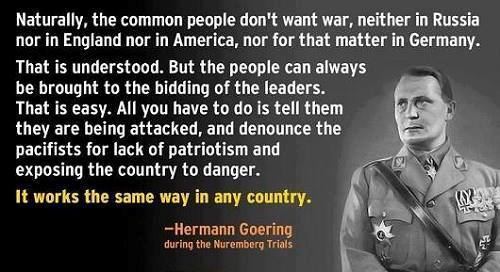
Throughout history, versions of the false flag attack have been used successfully by governments in order to direct the force of the people toward whatever end the so-called "powers that be" may be seeking. At times, that end may be war, or it may be the curtailing of domestic civil liberties and basic human rights. In others, it is an economic agenda.

Indeed, false flags are themselves capable of taking on a wide variety of forms – domestic or foreign, small or large, economic or political, and many other designations that can often blur into one another. Each may serve a specific purpose and each may be adjusted and tailored for that specific purpose as societal conditions require.

For instance, the chemical weapons attack which took place inside Syria in August 2013 serves as an example of a foreign false flag designed to whip up American fervor for war, on the platform of 'Responsibility to Protect', similar to the Gulf of Tonkin.

Domestically speaking (USA), a large-scale false flag such as 9/11, can be used to whip up both massive public support for war and a popular willingness to surrender civil liberties, constitutional procedure, and constitutional/human rights. Economic false flags may take the form of manufactured “government shutdowns” or “government defaults” designed to create a demand for austerity or other pro-Wall Street solutions. Lastly, smaller-scale domestic false flags such as Sandy Hook or Aurora, often involve the implementation of gun-control measures or a greater police state.

There are, of course, many different versions of false flag attacks and none fit into a tightly crafted classification beyond the generalized term “false flag.” As stated above, some false flags may indeed embrace an element of each of the different versions listed previously both in terms of methodology and purpose.

With that in mind, it is also true that, while massive false flag attacks are always a possibility, it has been the small-scale false flags coming in the form of “shooters” (most often of the “lone gunmen” variety), that have been used most effectively by the ruling class and its mouthpiece media outlets in recent years. While the scale of the attacks has diminished, their frequency has rapidly increased.

However, due to a growing competent alternative media and researching community, as fast as the false flag attacks are launched, a volley of deconstructions of the official narratives are being provided. While many criticisms of the official version of events are wildly incredible, bordering on paranoia and impossibility, there are capable outlets and researchers who are able to expose the false flag for what it is. Indeed, it is for this reason that the false flag has suffered serious setbacks in terms of its effectiveness as of late and why it continues to do so.

Because the false flag attack is designed to instill fear, panic, and a guided response from the general public, it is important to deconstruct the narrative of that attack as it is presented. However, we cannot simply be consumed by attempting to expose and deconstruct every false flag attack that comes our way. We cannot ignore the greater issues, the winnable battles, and the demands we must be making simply to expose each and every false flag. We cannot ignore the forest fire to extinguish the occasional burning bush. The false flag, after all, is only the symptom of the disease. For that reason, it is important to enable the general public to recognize the false flag event when it happens – thus rendering the attack neutral – and not simply the questionable elements of a particular false flag which will soon be overtaken by a new one.
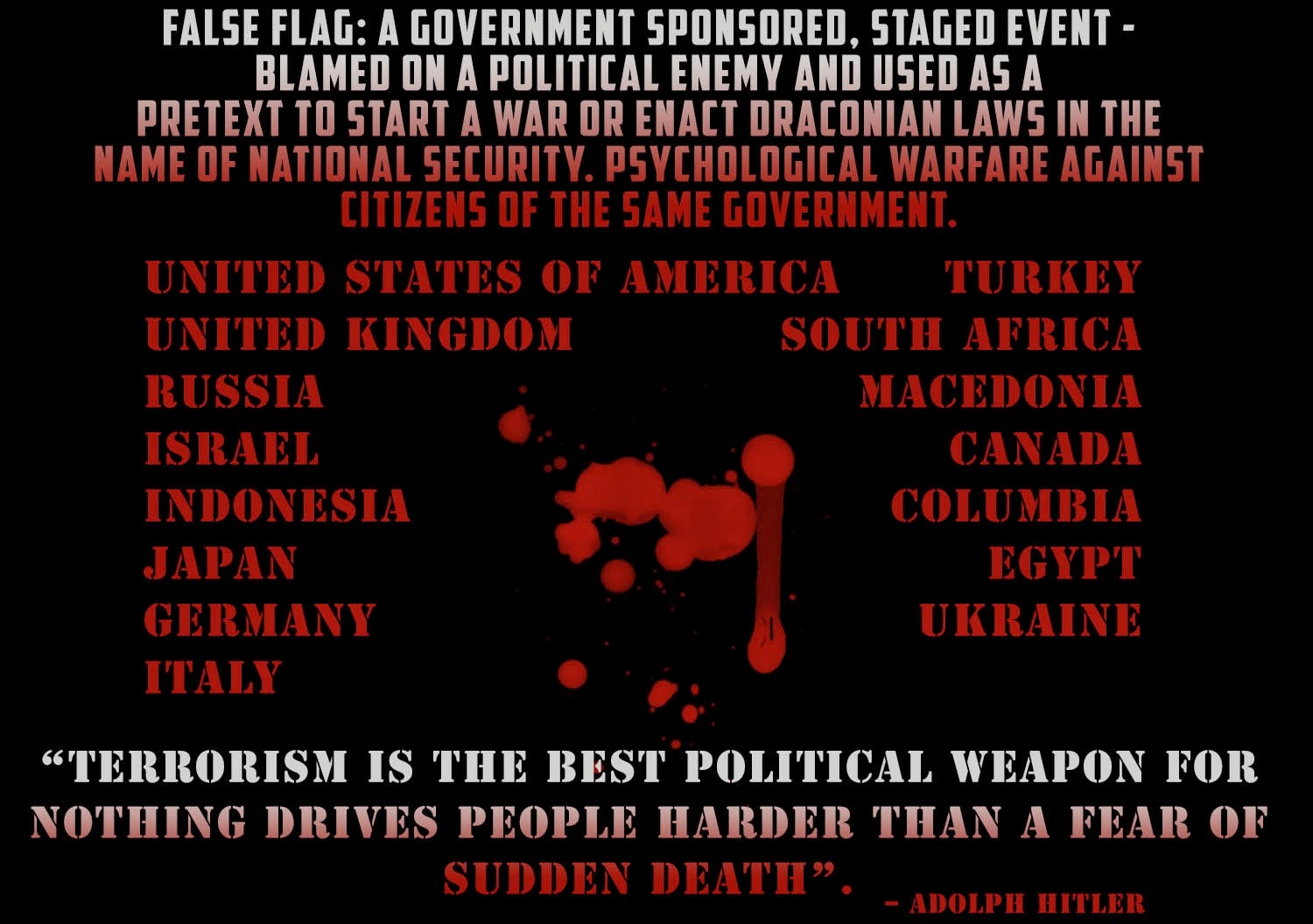

The following is a list of some of the most common elements of a false flag attack, which should immediately be looked at in the event of an incident that pulls at the heartstrings and emotions of the general public.

1. High Profile Event: The first question to ask would be “Is this a high profile incident?” The answer, of course, is fairly obvious. If an attack takes place at the World Trade Center complex causing the buildings to explode and collapse, or if it takes place at the White House, or Pentagon, it is clearly high profile. Thus, the location can be factored in. In other circumstances, however, the act itself may be the major factor such as the case in Sandy Hook Elementary School, a nationally unimportant location but a horrific act that made national news nonetheless. The most important factor, of course, is media attention. Regardless of location or the act, if the media picks up the story and runs it simultaneously on all major mainstream channels, the incident can be considered a “high profile event.”

2. Changing Stories: In informed researching circles, it is well-known that the information that comes out shortly after the event is usually the most reliable. This is not to discount the existence of confusion related to panicked reports coming from eyewitnesses and the like. However, the information coming out early on has not yet been subjected to the top-down media revision that will inevitably take place as the story becomes molded to fit the narrative pushed by the individuals who either directed the attack at the higher levels or at least have connections with those who are able to control the manner in which various media outlets report the event.
For instance, in times of false flag attacks, the initial reports may point to 5 gunmen. Very shortly after, reports may only mention two. Only a few hours after the attack, however, all references to more than one gunmen are removed entirely, with only the “lone gunman” story remaining. Any other mention of additional gunmen after this point is ridiculed as “conspiracy theory.”

3. Simultaneous Drills: Sometimes a false flag operation can be identified by the running of drills shortly before or during the actual attack. Many times, these drills will involve the actual sequence of events that takes place during the real-life attack. These drills have been present on large scale false flags such as 9/11 as well as smaller-scale attacks like the Aurora shooting.
For instance, as Webster Tarpley documents in his book 9/11 Synthetic Terror: Made In USA, at least 46 drills were underway in the months leading up to 9/11 and on the morning of the attack. These 46 drills were all directly related to the events which took place on 9/11 in some way or another. Likewise, the 7/7 bombings in London were running drills of exactly the same scenario that was occurring at exactly the same times and locations.

Although one reason may take precedence over the other depending on the nature and purpose of the operation drills are used by false flag operators for at least two reasons. One such purpose is the creation of intentional confusion if the drill is taking place during the actual attack. The other, more effective aspect, however, is using the drill as a cloak to plan the attack or even “go live” when it comes time to launch the event. Even more so, it gives the individuals who are involved in the planning of the event an element of cover, especially with the military/intelligence agency’s tight chain of command structure and need-to-know basis. If a loyal military officer or intelligence agent stumbles upon the planning of the attack, that individual can always be told that what he has witnessed is nothing more than the planning of a training exercise. This deniability continues all the way through to the actual “going live” of the drill. After the completion of the false flag attack, Coincidence Theory is used to explain away the tragic results.

4. Cui Bono? The most important question to ask immediately after any high profile incident is “cui bono?” or “Who benefits?” If one is able to see a clear benefit to any government, corporation, or bank, then the observer becomes capable of seeing through the false flag attack immediately. Many of these questions can be answered by taking a closer look at the behavior of these organizations prior to the attack and shortly thereafter.

For instance, the presence of legislation that would stand little chance of being passed before the attack, but which is quickly passed and/or heavily pushed afterward is one clue that the conveniently timed 'attack' was actually a government-orchestrated false flag operation.
Patriot Act style legislation was actually written before 9/11 but stood little chance of passing in Congress due to the political climate in the United States at the time. After 9/11, however, the Patriot Act was fast-tracked through both Houses of Congress with virtually no debate and with the blessing of the American people.

Returning to 9/11, it is a fact that a number of individuals who were in positions of power within the US government during the time the attack occurred had desperately wanted to invade several Middle Eastern countries. After the attacks, a war psychosis gripped the ruling class of the United States and the American public followed right along.

After the Underwear Bombing, we saw the rollout of the TSA full-body scanners, a technology that would not have been readily accepted prior to the incident and subsequent propaganda campaign. However, the scanners had been purchased one year earlier by a firm owned by Michael Chertoff, the former head of Homeland Security.
Likewise, in terms of the LAX shooting, TSA purchased 3.5 million dollars worth of ammunition in August. Yet, in August, TSA was not an armed agency. After the LAX shooting, however, talk has turned to arming the agency, thus indicating possible foreknowledge on the part of someone higher up in the governmental structure.
Of course, the same can be said for the explosion of crazed lone-gunman shooting sprees that took place all across the United States amid propaganda pushes for increased gun control measures.

5. Unanswered Questions: Another hallmark of the false flag operation is relatively obvious – the presence of unanswered questions regarding the details of the attack, the perpetrators, the motive and so on. Although the media narrative that takes shape soon after the attack will ignore these questions, they will inevitably remain if observers are able to think for themselves and focus only on the information. An example of such questions would be Building 7 on 9/11 or the questions of additional shooters at Aurora and Sandy Hook.

6. Case is quickly closed: Once an acceptable patsy and cover story is chosen by the media, all other opinions and questions are refused air time. Nothing that even slightly contradicts the official story is acknowledged as legitimate. Once this happens, the patsy, if still alive (in rare circumstances) is charged, prosecuted, and convicted in a largely secret or shadowy proceeding. In most cases, the suspect is killed in the process or shortly after the fact thus negating any first-hand contradiction of the official narrative. Either way, the case is closed very soon after the event.

7. Suspects’ Connection to CIA, FBI, or Other Intelligence Agencies: One key aspect suggesting a false flag that should be looked for soon after the attack is any possible connection the suspect or group of suspects may have had with intelligence agencies. A connection to any one of these organizations and institutions may go some length in explaining how the attack was coordinated, the motivation of the perpetrators, the actual involvement (or not) of the suspects, and who actually directed the operation. For instance, on 9/11, many of the alleged hijackers had previously had close contact with the FBI, CIA, and other high-level intelligence agencies (both home and abroad).[5] Likewise, the Tsarnaev brothers who have been accused of masterminding and carrying out the Boston Bombing had ties to the FBI before the attack.

In many instances, connections to certain military agencies and communities should serve as the same red flag as connections to intelligence agencies since these institutions have largely been blended together.

8. Convenient Scapegoat: One clue leading an informed observer to suspect a false flag attack is the existence of the convenient scapegoat. Any false flag operation will have a carefully crafted narrative complete with a group of individuals set up for demonization. The OKC bombing had McVeigh and thus, “right-wing extremists” and “militias.” On 9/11, the group was Muslims. In many of the domestic shooting sprees, the demonization was set for gun owners. With the recent LAX shooting, the “perpetrator” was an “anti-government conspiracy theorist.” In the instance of the false flag, a readily identified pasty will exhibit all or most of the aspects of the group and social demographic set to be demonized.

9. Media Promotes A Narrative Against Scapegoat Groups and/or An Agenda To Take Liberties: One clue suggesting a false flag is that, immediately after the attack and after the perpetrators have been “identified” by “officials” and the corporate media outlets begin not only demonizing the demographic group to which the “perpetrator” belongs, but begins promoting “solutions” in order to prevent such an attack from ever happening again. This narrative will always involve the erosion of liberties, the greater implementation of a police state, a specific economic policy, or a march to war.

Simply put, the media promotes the PROBLEM, allows for and guides the REACTION, and then provides the pre-determined SOLUTION.

10. Government Begins to “Take Action” Against the Scapegoat or Moves Along the Lines of the Media Narrative: After a healthy dose of propaganda from mainstream media outlets regurgitating the terror of the attack, the perpetrator, and the police state solutions, the government then begins to take action. Political speeches are given in order to capitalize on the fear and anger felt by the public and in order to reinforce the idea that government is there to act as a protector. Political solutions are then offered as bills, executive orders, or political mandates whether it is the curtailment of the 4th Amendment, gun control, or military strikes on a foreign country.

Conclusion:

Although it is extremely important to educate the general public as to the nature and purpose of false flags, education cannot be a goal in and of itself. The public not only needs to know the truth surrounding specific false flag events as they appear, but they also need to understand the methodology of identifying them on their own and in real-time.

Edited from: Activistpost.com

Related

Counter-Intelligence

The Business of War: How Federal And Private Military Contractors Profit From War

The Business of War: SOFEX

The Malaysian Airliner Isn’t Missing – It Is Exactly Where Somebody Has Designed It To Be

Posted on the frontpage in April 2014

Edited from the Project Avalon Forum. My additions are in italic.

The Malaysian airplane (MH370) is not missing. It is exactly where somebody has designed it to be. With the technology that is in existence today, it is literally impossible for anyone or anything – especially a passenger plane weighing 656,000 lbs – to vanish without leaving a trace.

Flightradar24.com – Live air traffic

Are the 'officials' really trying to make believe that the combined surveillance equipment and technology of the NSANASAECHELON and NORAD is unable to locate this aircraft??

Please..

If a plane the size of a Boeing 777 with 200+ passengers crashes into the ocean there are many, many parts of the wreckage that will visibly float. Clothes, suitcases, handbags, plastic food containers, life jackets – the list goes on and on and on – will be immediately visible. The debris doesn't 'suddenly appear' after 20 or more days. Not a single passenger or crew member made it into a life raft??  I mean seriously – WTF

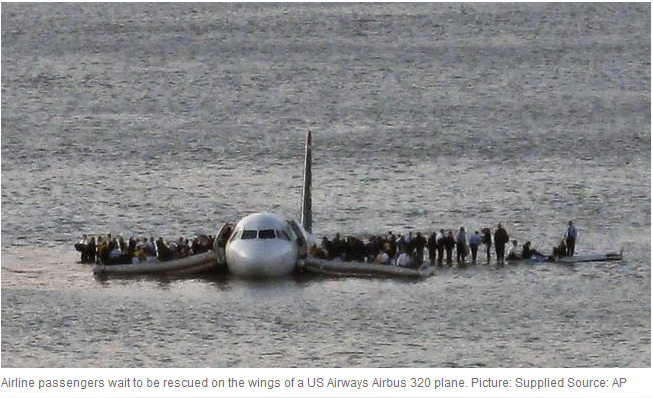
In January 2009 a US Airways flight lost engine power when it was struck by a flock of geese after taking off from New York's LaGuardia Airport. Capt. Chesley B. "Sully" Sullenberger ditched the Airbus A320 in the Hudson River and all 155 people on-board survived. The crash was dubbed the "Miracle on the Hudson".

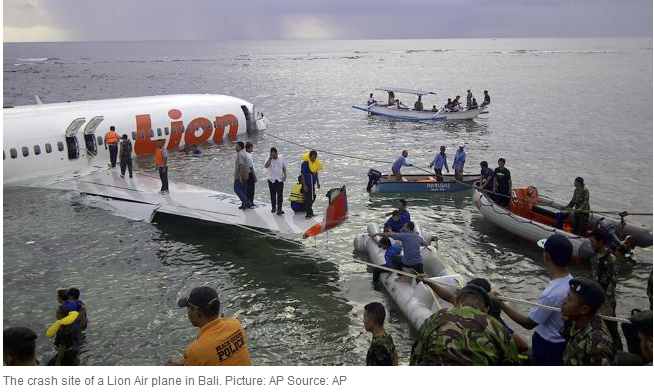
In April 2013, a Boeing 737 flown by Indonesian airline Lion Air crashed into water short of a runway in Bali. The plane's fuselage split into two sections but all 108 people on board survived. "What's really important is for people to understand that airplane crashes, the majority of them are survivable," Deborah Hersman, chairwoman of the National Transportation Safety Board told CBS at the time.


SourceFive reasons plane crashes are now more survivable

Ethiopian Airlines Flight 961, a Boeing 767-200ER, was hijacked on 23 November 1996, en route from Addis Ababa to Nairobi on a Bombay–Addis Ababa–Nairobi–Brazzaville–Lagos–Abidjan service, by three Ethiopians seeking asylum in Australia. The plane crash-landed in the Indian Ocean near Grande Comore, Comoros Islands, due to fuel starvation; 125 of the 175 passengers and crew on board died, along with the hijackers; the rest of the people on board survived with injuries.

If you seriously believe that flight MH370, which was a Boeing 777-2H6ER with a wingspan of 199 ft 11 in (60.9 m) and a tail height of 60 ft 9 in (18.5 m), could just vanish without leaving ANY traceable wreckage, you'll believe anything.

The Malaysian airliner could only have disintegrated in flight if it was targeted with a Directed Energy Weapon. If you don't know what a DEW is you can click here to read more. I would especially like to direct you to the first segment on page 41 of this presentation: The E-Bomb – A Weapon Of Electrical Mass Destruction.

Speaking of mass destruction; with 80,000 Russian troops poised to invade Ukraine and with NATO moving forces into Norway, there is a war that could break out any day.

These two events and many other (current) world events are staged in order to create maximum chaos and a pretext to roll out The New World Order. The New World Order is the grand fantasy of a few so-called elites and its ultimate goal is complete control of the population and the centralization of power in a One World Government. Just like 9/11, the disappearance of Malaysian airlines MH370 was without a doubt an inside job.

Do I have to say it again? Something that weighs 656,000 lbs doesn't just vanish into thin air.

Stop watching television, do your own research and think for yourself.


Facebook’s Future Plans for Data Collection Beyond All Imagination

Created on Saturday, 31 May 2014 09:44

Facebook's dark plans for the future are given away in its patent applications.

“No one knows who will live in this cage in the future, or whether at the end of this tremendous development, entirely new prophets will arise, or there will be a great rebirth of old ideas and ideals, or, if neither, mechanized petrification, embellished with a sort of convulsive self-importance. For of the fast stage of this cultural development, it might well be truly said: ‘Specialists without spirit, sensualists without heart; this nullity imagines that it has attained a level of civilization never before achieved.’”

—Max Weber, 1905

 On November 12, 2013, Facebook, Inc. filed its 178th patent application for a consumer profiling technique the company calls “inferring household income for users of a social networking system.”

“The amount of information gathered from users,” explain Facebook programmers Justin Voskuhl and Ramesh Vyaghrapuri in their patent application, “is staggering — information describing recent moves to a new city, graduations, births, engagements, marriages, and the like.” Facebook and other so-called tech companies have been warehousing all of this information since their respective inceptions. In Facebook’s case, its data vault includes information posted as early as 2004, when the site first went live. Now in a single month the amount of information forever recorded by Facebook —dinner plans, vacation destinations, emotional states, sexual activity, political views, etc.— far surpasses what was recorded during the company’s first several years of operation. And while no one outside of the company knows for certain, it is believed that Facebook has amassed one of the widest and deepest databases in history. Facebook has over 1,189,000,000 “monthly active users” around the world as of October 2013, providing considerable width of data.

Facebook has also stored away trillions and trillions of missives and images and logged other data about the lives of this billion plus statistical sample of humanity. Adjusting for bogus or duplicate accounts it all adds up to about 1/7th of humanity from which some kind of data has been recorded.

According to Facebook’s programmers like Voskuhl and Vyaghrapuri, of all the clever uses they have already applied this pile of data toward, Facebook has so far “lacked tools to synthesize this information about users for targeting advertisements based on their perceived income.” Now they have such a tool thanks to the retention and analysis of variables the company’s positivist specialists believe are correlated with income levels.

They’ll have many more tools within the next year to run similar predictions. Indeed, Facebook, Google, Yahoo, Twitter, and the hundreds of smaller tech lesser-known tech firms that now control the main portals of social, economic, and political life on the web (which is now to say everywhere as all economic and much social activity is made cyber) are only getting started. The Big Data analytics revolutions have barely begun, and these firms are just beginning to tinker with rational-instrumental methods of predicting and manipulating human behavior.

There are few, if any, government regulations restricting their imaginations at this point. Indeed, the U.S. President himself is a true believer in Big Data; the brain of Obama’s election team was a now-famous “cave” filled with young Ivy League men (and a few women) sucking up electioneering information and crunching demographic and consumer data to target individual voters with appeals timed to maximize the probability of a vote for the new Big Blue, not IBM, but the Democratic Party’s candidate of “Hope” and “Change.” The halls of power are enraptured by the potential of rational-instrumental methods paired with unprecedented access to data that describes the social lives of hundreds of millions.

Facebook’s intellectual property portfolio reads like cliff notes summarizing the aspirations of all corporations in capitalist modernity; to optimize efficiency in order to maximize profits and reduce or externalize risk. Unlike most other corporations, and unlike previous phases in the development of rational bureaucracies, Facebook and its tech peers have accumulated never before seen quantities of information about individuals and groups. Recent breakthroughs in networked computing make an analysis of these gigantic data sets fast and cheap. Facebook’s patent holdings are just a taste of what’s arriving here and now.

The way you type, the rate, common mistakes, intervals between certain characters, are all unique, like your fingerprint, and there are already cyber robots that can identify you as you peck away at keys. Facebook has even patented methods of individual identification with obviously cybernetic overtones, where the machine becomes an appendage of the person. U.S. Patents 8,306,256, 8,472,662, and 8,503,718, all filed within the last year, allow Facebook’s web robots to identify a user based on the unique pixelation and other characteristics of their smartphone’s camera. Identification of the subject is the first step toward building a useful data set to file among the billion or so other user logs. Then comes analysis, then prediction, then efforts to influence a parting of money.

Many Facebook patents pertain to advertising techniques that are designed and targeted, and continuously redesigned with ever-finer calibrations by robot programs, to be absorbed by the gazes of individuals as they scroll and swipe across their Facebook feeds, or on third-party web sites.

Speaking of feeds, U.S. Patent 8,352,859, Facebook’s system for “Dynamically providing a feed of stories about a user of a social networking system” is used by the company to organize the constantly updated posts and activities inputted by a user’s “friends.” Of course, embedded in this system are means of inserting advertisements. According to Facebook’s programmers, a user’s feeds are frequently injected with “a depiction of a product, a depiction of a logo, a display of a trademark, an inducement to buy a product, an inducement to buy a service, an inducement to invest, an offer for sale, a product description, trade promotion, a survey, a political message, an opinion, a public service announcement, news, a religious message, educational information, a coupon, entertainment, a file of data, an article, a book, a picture, travel information, and the like.” That’s a long list for sure, but what gets injected is more often than not whatever will boost revenues for Facebook.

The advantage here, according to Facebook, is that “rather than having to initiate calls or emails to learn news of another user, a user of a social networking website may passively receive alerts to new postings by other users.” The web robot knows best. Sit back and relax and let sociality wash over you, passively. This is merely one of Facebook’s many “systems for tailoring connections between various users” so that these connections ripple with ads uncannily resonant with desires and needs revealed in the quietly observed flow of e-mails, texts, images, and clicks captured forever in dark inaccessible servers of Facebook, Google and the like. These communications services are free in order to control the freedom of data that might otherwise crash about randomly, generating few opportunities for sales.

Where this fails Facebook ratchets up the probability of influencing the user to behave as a predictable consumer. “Targeted advertisements often fail to earn a user’s trust in the advertised product,” explain Facebook’s programmers in U.S. Patent 8,527,344, filed in September of this year. “For example, the user may be skeptical of the claims made by the advertisement. Thus, targeted advertisements may not be very effective in selling an advertised product.” Facebook’s computer programmers who now profess mastery over sociological forces add that even celebrity endorsements are viewed with skepticism by the savvy citizen of the modulated Internet. They’re probably right.

Facebook’s solution is to mobilize its users as trusted advertisers in their own right. “Unlike advertisements, most users seek and read content generated by their friends within the social networking system; thus,” concludes Facebook’s mathematicians of human inducement, “advertisements generated by a friend of the user are more likely to catch the attention of the user, increasing the effectiveness of the advertisement.” That Facebook’s current So-And-So-likes-BrandX ads are often so clumsy and ineffective does not negate the qualitative shift in this model of advertising and the possibilities of un-freedom it evokes.

Forget iPhones and applications, the tech industry’s core consumer product is now advertising. Their essential practice is mass surveillance conducted in real-time through continuous and multiple sensors that pass, for most people, entirely unnoticed. The autonomy and unpredictability of the individual —in Facebook’s language the individual is the “user”— is their fundamental business problem. Reducing autonomy via surveillance and predictive algorithms that can placate existing desires, and even stimulate and mold new desires is the tech industry’s reason for being. Selling their capacious surveillance and consumer stimulus capabilities to the highest bidder is the ultimate end.

Sounds too dystopian? Perhaps, and this is by no means the world we live in, not yet. It is, however, a tendency rooted in the tech economy. The advent of mobile, hand-held, wirelessly networked computers, called “smartphones,” is still so new that the technology and its services feel like a parallel universe, a new layer of existence added upon our existing social relationships, business activities, and political affiliations. In many ways it feels liberating and often playful. Our devices can map geographic routes, identify places and things, provide information about almost anything in real-time, respond to our voices, and replace our wallets. Who hasn’t consulted “Dr. Google” to answer a pressing question? Everyone and everything is seemingly within reach and there is a kind of freedom to this utility.

Most of Facebook’s “users” have only been registered on the web site since 2010, and so the quintessential social network feels new and fun, and although perhaps fraught with some privacy concerns, it does not altogether fell like a threat to the autonomy of the individual. To say it is a cliche sci-fi nightmare narrative of tech-bureaucracy, and we all tell one another that the reality is more complex.

Privacy continues, however, to be too narrowly conceptualized as a liberal right against incursions of government, and while the tech companies have certainly been involved in a good deal of old-fashioned mass surveillance for the sake of our federal Big Brother, there’s another means of dissolving privacy that is more fundamental to the goals of the tech companies and more threatening to social creativity and political freedom.

Georgetown University law professor Julie Cohen notes that pervasive surveillance is inimical to the spaces of privacy that are required for liberal democracy, but she adds importantly, that the surveillance and advertising strategies of the tech industry go further.

“A society that permits the unchecked ascendancy of surveillance infrastructures, which dampen and modulate behavioral variability, cannot hope to maintain a vibrant tradition of cultural and technical innovation,” writes Cohen in a forthcoming Harvard Law Review article.

“Modulation” is Cohen’s term for the tech industry’s practice of using algorithms and other logical machine operations to mine an individual’s data so as to continuously personalize information streams. Facebook’s patents are largely techniques of modulation, as are Google’s and the rest of the industry leaders. Facebook conducts meticulous surveillance on users, collects their data, tracks their movements on the web, and feeds the individual specific content that is determined to best resonate with their desires, behaviors, and predicted future movements. The point is to perfect the form and function of the rational-instrumental bureaucracy as defined by Max Weber: to constantly ratchet up efficiency, calculability, predictability, and control. If they succeed in their own terms, the tech companies stand to create a feedback loop made perfectly to fit each and every one of us, an increasingly closed system of personal development in which the great algorithms in the cloud endlessly tailor the psychological and social inputs of humans who lose the gift of randomness and irrationality.

“It is modulation, not privacy, that poses the greater threat to innovative practice,” explains Cohen. “Regimes of pervasively distributed surveillance and modulation seek to mold individual preferences and behavior in ways that reduce the serendipity and the freedom to tinker on which innovation thrives.” Cohen has pointed out the obvious irony here, not that it’s easy to miss; the tech industry is uncritically labeled America’s hothouse of innovation, but it may in fact be killing innovation by disenchanting the world and locking inspiration in a cage.

If there were limits to the reach of the tech industry’s surveillance and stimuli strategies it would indeed be less worrisome. Only parts of our lives would be subject to this modulation, and it could therefore benefit us. But the industry aspires to totalitarian visions in which universal data sets are constantly mobilized to transform an individual’s interface with society, family, the economy, and other institutions. The tech industry’s luminaries are clear in their desire to observe and log everything and use every “data point” to establish optimum efficiency in life as the pursuit of consumer happiness. Consumer happiness is, in turn, a step toward the rational pursuit of maximum corporate profit. We are told that the “Internet of things” is arriving, that soon every object will have embedded within it a computer that is networked to the sublime cloud, and that the physical environment will be made “smart” through the same strategy of modulation so that we might be made free not just in cyberspace, but also in the meatspace.

Whereas the Internet of the late 1990s matured as an archipelago of innumerable disjointed and disconnected web sites and databases, today’s Internet is gripped by a handful of giant companies that observe much of the traffic and communications, and which deliver much of the information from an Android phone or laptop computer, to distant servers, and back. The future Internet being built by the tech giants —putting aside the Internet of things for the moment— is already well into its beta testing phase. It’s a seamlessly integrated quilt of web sites and apps that all absorb “user” data, everything from clicks and keywords to biometric voice identification and geolocation.

United States Patent 8,572,174, another of Facebook’s recent inventions, allows the company to personalize a web page outside of Facebook’s own system with content from Facebook’s databases. Facebook is selling what the company calls its “rich set of social information” to third party web sites in order to “provide personalized content for their users based on social information about those users that is maintained by, or otherwise accessible to, the social networking system.” Facebook’s users generated this rich social information, worth many billions of dollars as recent quarterly earnings of the company attest.

In this way the entire Internet becomes Facebook. The totalitarian ambition here is obvious, and it can be read in the securities filings, patent applications, and other non-sanitized business documents crafted by the tech industry for the financial analysts who supply the capital for further so-called innovation. Everywhere you go on the web, with your phone or tablet, you’re a “user,” and your social network data will be mined every second by every application, site, and service to “enhance your experience,” as Facebook and others say. The tech industry’s leaders aim to expand this into the physical world, creating modulated advertising and environmental experiences as cameras and sensors track our movements.

Facebook and the rest of the tech industry fear autonomy and unpredictability. The ultimate expression of these irrational variables that cannot be mined with algorithmic methods is the absence from the networks of surveillance in which data is collected.

One of Facebook’s preventative measures is United States Patent 8,560,962, “promoting the participation of low-activity users in the social networking system.” This novel invention devised by programmers in Facebook’s Palo Alto and San Francisco offices involves a “process of inducing interactions,” that are meant to maximize the amount of “user-generated content” on Facebook by getting lapsed users to return, and stimulating all users to produce more and more data. User-generated content is, after all, worth billions. Think twice before you hit “like” next time, or tap that conspicuously placed “share” button; a machine likely put that content and interaction before your eyes after a logical operation determined it to have the highest probability of tempting you to add to the data stream, thereby increasing corporate revenues.

Facebook’s patents on techniques of modulating “user” behavior are few compared to the real giants of the tech industry’s surveillance and influence agenda. Amazon, Microsoft, and of course Google hold some of the most fundamental patents using personal data to attempt to shape an individual’s behavior into predictable consumptive patterns. Smaller specialized firms like Choicestream and Gist Communications have filed dozens more applications for modulation techniques. The rate of this so-called innovation is rapidly telescoping.

Perhaps we do know who will live in the iron cage. It might very well be a cage made of our own user-generated content, paradoxically ushering in a new era of possibilities in shopping convenience and the delivery of satisfactory experiences even while it eradicates many degrees of chance, and pain, and struggle (the motive forces of human progress) in a robot-powered quest to have us construct identities and relationships that yield to prediction and computer-generated suggestion. Defense of individual privacy and autonomy today is rightly motivated by the reach of an Orwellian security state (the NSA, FBI, CIA). This surveillance changes our behavior by chilling us, by telling us we are always being watched by an authority. Authority thereby represses in us whatever might happen to be defined as “crime,” or any anti-social behavior at the moment. But what about the surveillance that does not seek to repress us, the watching computer eyes and ears that instead hope to stimulate a particular set of monetized behaviors in us with the intimate knowledge gained from our every online utterance, even our facial expressions and finger movements?

Darwin Bond-Graham, a contributing editor to CounterPunch, is a sociologist and author who lives and works in Oakland, CA. His essay on economic inequality in the “new” California economy appears in the July issue of CounterPunch magazine. He is a contributor to Hopeless: Barack Obama and the Politics of Illusion

Source: Alternet.org


Additional comments from me:

The corporations that own the social media outlets capitalize (yes, CAPITALIZE) on peoples, oftentimes insatiable, need be seen, to be heard, and to be popular (..Facebook, iPhone or better yet iEverything, YouTube). From early childhood on most human beings have been programmed to believe that you only matter if you win, if you’re "out there" and if lots of other people pay attention to you.

While I acknowledge that social media can serve a useful purpose as a means of staying in touch or connecting with others of like mind, friends, and loved ones, I strongly advise that you do not live your life on those outlets.

Cyber connections cannot replace actual human interaction and your 1700 Facebook ‘friends’, 5000 Twitter followers and 500+ LinkedIn connections, will not all be there with a bowl of soup when you’ve caught a cold. 

And I know, it begs the question would you even want them to since you couldn’t possibly consume such quantities, but I think I've made my point.


The US Government Shutdown vs The US Breaching The Debt Ceiling

Created on Thursday, 14 November 2013 14:24

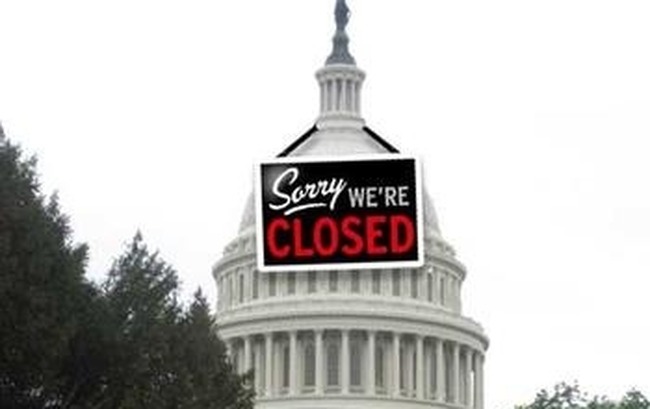
On June 11, 2013 the Congressional Budget Office released its estimate on when the United States will officially hit the debt ceiling — an event that will no doubt provoke another maelstrom of gridlock and bickering on Capitol Hill.
Since provisions of the No Budget, No Pay Act of 2013 (HR 325) took effect in May, the federal debt limit has been suspended at exactly $16,699,421,095,673.60. Default on the debt has been held in check by Treasury’s full arsenal of extraordinary measures, but according to Treasury Secretary Jacob J. Lew, the U.S. will have exhausted the measures to avoid breaching the debt ceiling on October 17th.

Beneath the vagueness of the term “extraordinary measures” is a series of shuffled investments and suspended securities issuances intended to constrain debt held, making room for additional borrowing. About half of the U.S. debt is held by foreign governments, central banks and other overseas investors, according to Treasury data. China is the largest holder of U.S. Treasuries, with $1.3 trillion in July 2013. Japan follows with $1.1 trillion. 

Pushing the US closer towards the ceiling are the daily cash flows of the federal government and debt issuance by the Treasury through scheduled interest payments and debt auctioning. Expenditures to Medicare, Social Security, benefits for active-duty military and veterans, and interest payments — offset by tax revenues collected from individuals and corporations — are the primary drivers of cash flows. The precise date the debt limit is reached depends entirely on how long the Treasury’s extraordinary measures can stave off the uncertain magnitude of these cash flows and key debt transactions.

Why a breach of the debt ceiling is MUCH worse than the government shutdown

A government shutdown is problematic but decidedly noncatastrophic because the prevailing interpretation of the law is specifically designed to avoid catastrophe.

The debt ceiling is another matter.

Nobody really knows what will happen if the debt ceiling is breached because it’s never happened before and there is no legal provision for not making it a disaster. A breach is sometimes characterized as a default on the national debt. But it’s actually weirder than that. Normally the way things work is that the Treasury Department cuts the checks Congress has told it to cut, collects the taxes Congress has told it to collect and borrows to cover the difference.
But the statutory debt ceiling also instructs Treasury not to borrow more than a certain amount of money. When this debt ceiling is hit the Treasury will lack the legal authority to borrow any more money, to close the gap between spending and tax revenue. In order to avoid a breach of the debt ceiling, the US Congress would have to vote to raise the debt ceiling yet AGAIN, further ballooning the ever increasing and completely unsustainable US debt.

This 'solution' would be a very temporary one and it immediately raises the question, of how many more times the debt ceiling can be raised before the US goes completely bust.

While a short-lived default might be fixed without major damage to the global economy, drawing a line between short and long isn’t easy, according to Evercore’s Altman. “If you missed an interest payment by two hours, the markets might look entirely beyond that and forgive you,” Altman said. “If you miss an interest payment by two days, four days, six days, that’s a different story. It’s very difficult to be scientific about this.”

If the US does indeed default on its debt the US Administration is basically left with three options.

Obama could decide that the government’s legal obligation to spend (and certain elements of the 14th Amendment) trump the statutory debt ceiling, and just order the Treasury to sell more bonds. This course of action would in effect mean that the executive branch and the Federal Reserve just ignore the law by pretending that the debt ceiling doesn't bind, while trying to create a constitutional crisis to forestall a financial one.

The second option is that Obama could instruct the Treasury to pay some of the government’s bills and just not pay the rest.

The third option is to pay nobody.

These three options face the same basic problem namely, they're illegal! (The second one also faces the problem that Treasury lacks the logistical capacity to do it.)

The general consensus is that the third option would, among other things, provoke a global financial crisis by causing a default on U.S. Treasury bonds—bonds that are meant to be the safest asset in the financial system.

In general, simply nobody knows what anyone should do about anything if the debt ceiling is breached. Unlike with the shutdown, there is no overriding OMB (Office of Management and Budget) guidance. There are no rules to spell out essential versus nonessential services. Officially there’s no contingency planning at all.

And that’s the big difference between these two events. There hasn’t been a government shutdown in a while but they were common in the 1970s and 1980s. They’re a big deal in Washington, D.C. because federal employees don’t get paid when they happen.  A debt ceiling breach, by contrast, is completely unprecedented. There’s no guarantee that it’ll lead to a worldwide financial panic and a massive global depression, but there’s honestly no guarantee that it won’t.

Sources: Slate.com, Policymic.com, Bloomberg.com  (I edited the articles)  

Additional comments from me: I've said it a thousand times and I'll say it again: countries, companies and individuals CANNOT borrow their way out of debt. Drastically cutting the defense budget would be the first step in the right direction, but since the United States basically has a war driven economy it’s blatantly obvious that will not happen.

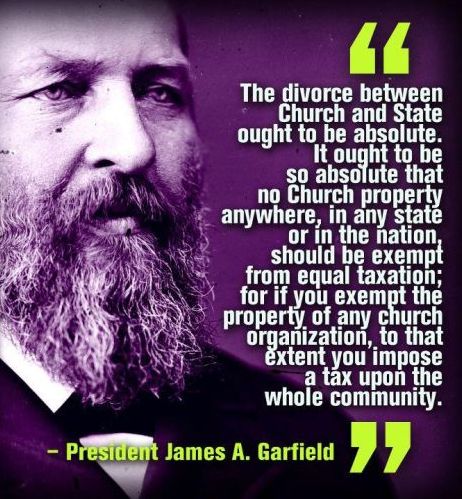
Making churches and religious organizations pay taxes on their income and assets instead of the poor would be a very good second step in the right direction and here's why. 

Churches and religious organizations are generally exempt from income tax and receive other favorable treatment under the tax law. Although the tax law also states that certain income of a church or religious organization may be subject to the 'Unrelated Business Income Tax', in general – and I quote – "..rents from real property, royalties, capital gains, and interest and dividends are not subject to the Unrelated Business Income Tax unless financed with borrowed money."

In other words: as long as churches or religious institutions don't invest with borrowed money, they pay no taxes over the income generated by those investments. (!!!) 

Churches and religious institutions literally take in billions and billions of dollars over which they pay NO taxes whatsoever. No wonder then that The Vatican has its own bank.

It should be clear by now – even to the innocent bystander – that the terminally insane “powers that be” will choose a financial Armageddon over creating a sustainable global financial system.